

Understanding Access Methods and Designing Access Points
Inclusive education requires that all students can access the curriculum, not only in theory, but in daily practice. This course explores how educators can recognize and design for diverse access needs, including physical, sensory, cognitive, communicative, and cultural considerations. Participants will learn how to identify student access methods, reduce environmental and instructional barriers, and create multiple, meaningful points of entry into learning for all.
Start Here
Welcome to the course! This learning experience is designed to help you explore inclusive education through a blend of practical strategies and powerful storytelling. Before diving into the course content, your first step is to choose the story that will guide your learning.
About This Course
This course supports you in building inclusive, flexible learning environments that recognize and amplify the strengths of every learner. While you’ll deepen your understanding through interactive learning interludes, everything begins with story.
Each course is anchored in a set of narrative case studies—realistic, practice-based stories that illuminate inclusive strategies in action. These stories will help you reflect, connect, and see how the course concepts apply in real school contexts.
Choose Your Story
Each story features:
-
A Prologue to set the scene
-
Four Chapters that trace growth, tension, and change
-
An Epilogue to reflect on learning and impact
Choose one story to follow throughout the course. Pick the one that most closely matches your role, context, or interests. This story will provide a consistent lens as you move through the learning interludes and activities.
Not sure which to choose? No problem. You can always return to this page to explore other stories. Many learners choose to follow more than one story to see how inclusive practices come to life in different settings.
What Happens Next?
Once you’ve chosen your story:
-
If you're learning independently, head to the Course Content section and begin with Learning Interlude 1.
-
If you're learning with a facilitator, they’ll guide you through the journey using the facilitation materials provided.
You're ready to begin. Scroll down to explore the stories and pick the one that will guide your path through the course.


Samir’s Story: Tactile Paths to Participation
When Samir, a blind Grade 1 student, joins Ms. Wren’s classroom at Harvest Hill Elementary mid-year, the team is excited to welcome him—but quickly recognizes that inclusion requires more than goodwill. Ms. Wren realizes her current classroom setup, materials, and routines are largely inaccessible to a student who cannot rely on visual cues. Worksheets dominate her instruction, centers rely on pictures, and transitions are marked with visual prompts alone. While she has a strong desire to make learning inclusive, she doesn’t yet know how.
Instead of relying on generic accommodations, Ms. Wren begins a collaborative journey. She reaches out to the school’s learning support teacher and connects with a Teacher for the Visually Impaired (TVI), opening up new possibilities for design. With their help, she begins to recognize the difference between simply modifying tasks and intentionally designing access from the start.
Over the course of the story, Samir’s experience becomes a catalyst for transformation—not only for Ms. Wren’s classroom but for the broader school community. Through tactile tools, spatial orientation strategies, collaborative exploration, and multisensory learning routines, Samir becomes an active, confident participant. Peers shift from curiosity to genuine partnership, learning to communicate and collaborate in new ways. Other students begin to benefit from the multimodal changes too—particularly those with language processing difficulties, ADHD, and emerging language skills.
This is not just a story of adapting for one child; it’s a story of how deeply inclusive practice begins with a commitment to understanding access and grows into a classroom culture rooted in creativity, collaboration, and equity.
-
Prologue - Listening With New Eyes ( 📖 Read | 🎧 Listen | 🎬 Watch )
-
Chapter 1 - Rebuilding the Classroom ( 📖 Read | 🎧 Listen | 🎬 Watch )
-
Chapter 2 - Expanding the Toolkit ( 📖 Read | 🎧 Listen | 🎬 Watch )
-
Chapter 3 - Partnering for Access ( 📖 Read | 🎧 Listen | 🎬 Watch )
-
Chapter 4 - Partnering for Growth ( 📖 Read | 🎧 Listen | 🎬 Watch )
-
Epilogue - Seeing in New Ways ( 📖 Read | 🎧 Listen | 🎬 Watch )

A School That Speaks Together
At Riverstone Elementary, teachers and support staff begin to notice a pattern. More students are arriving with Augmentative and Alternative Communication (AAC) needs. These students use speech-generating devices, symbol boards, or gestures to communicate. While the school has always valued inclusion, these students often sit at the edges of classroom conversations. Teachers rely heavily on educational assistants or speech-language pathologists for support, unintentionally limiting communication to adult-managed moments. Staff begin asking questions: How do we bring AAC into the center of classroom life, rather than keeping it at the periphery?
In one staff meeting, a school-based speech-language pathologist (SLP) proposes a radical but simple shift: What if AAC wasn’t just for a few students? What if the school implemented a universal core word approach, embedding visual supports and shared vocabulary across all classrooms and activities? The idea receives a mix of excitement and hesitation. Some teachers worry about adding more to their already full plates, but others are intrigued by the possibility of creating a truly communicative culture for all students.
With support from leadership and the SLP, the school begins slowly. Teachers try modeling one or two core words each week. Visuals are introduced in classroom routines, morning meetings, and hallway transitions. Educational assistants begin co-planning with teachers. Students who had once remained silent begin engaging—first with symbols, then gestures, and eventually with increased confidence and connection. As the months progress, what began as an AAC strategy for a handful of learners grows into a whole-school movement. The shift fosters greater empathy, awareness, and inclusivity, where all voices, no matter how they are expressed, are honored and heard.
-
Prologue - A Language We All Can Share ( 📖 Read | 🎧 Listen | 🎬 Watch )
-
Chapter 1 - Everyone Needs a Way In ( 📖 Read | 🎧 Listen | 🎬 Watch )
-
Chapter 2 - Shared Language ( 📖 Read | 🎧 Listen | 🎬 Watch )
-
Chapter 3 - Everyone Means Everyone ( 📖 Read | 🎧 Listen | 🎬 Watch )
-
Chapter 4 - Language Embedded ( 📖 Read | 🎧 Listen | 🎬 Watch )
-
Epilogue - Building a Culture of Access ( 📖 Read | 🎧 Listen | 🎬 Watch )

Tanya’s Story: Coaching for Energy, Access, and Autonomy
At Wayfinder Middle School, Tanya works as an inclusive education coach with a growing awareness of an often-overlooked issue: the hidden challenges faced by students with chronic health conditions, fatigue disorders, and energy regulation needs. These students—some navigating long-term medical conditions, others managing post-viral fatigue or neurological differences—frequently miss out on full classroom participation, not because they lack ability, but because school structures rarely accommodate fluctuating energy levels. Tanya notices these students are absent more often, disengaged when present, and left behind in group tasks or assessments. Their needs are not always visible, and as a result, their potential is too often underestimated.
Rather than implementing rigid accommodations, Tanya begins by listening. She talks with students, meets with families, and reflects with teachers. What emerges is a clearer picture: students need options—not just for tasks, but for how and when they engage. They need classrooms that allow for rest without shame, participation without penalty, and pacing that respects their bodies. Tanya begins developing a coaching model rooted in universal design, trauma-informed pacing, and energy-aware planning.
Through collaborative design cycles, Tanya supports teams in reimagining classroom routines, expectations, and even grading practices. She helps teachers create flexible entry points, modify timing structures, and offer choice in how students demonstrate learning. As Tanya’s work unfolds, it catalyzes a shift from compliance-based inclusion to dignity-centered design—where students with invisible disabilities are seen, supported, and celebrated for who they are.
-
Prologue - Not Just a Diagnosis ( 📖 Read | 🎧 Listen | 🎬 Watch )
-
Chapter 1 - Piecing Together the Day ( 📖 Read | 🎧 Listen | 🎬 Watch )
-
Chapter 2 - More Than One Way ( 📖 Read | 🎧 Listen | 🎬 Watch )
-
Chapter 3 - Side by Side Planning ( 📖 Read | 🎧 Listen | 🎬 Watch )
-
Chapter 4 - Community of Care ( 📖 Read | 🎧 Listen | 🎬 Watch )
-
Epilogue - A Widened Circle ( 📖 Read | 🎧 Listen | 🎬 Watch )

Jeremy’s Story: Designing with, Not For
Jeremy is a bright and ambitious high school student with cerebral palsy who attends Prairie View School, a rural K–12 school working to become more inclusive. While Jeremy excels in academic subjects and demonstrates strong leadership skills, his participation in science labs and physical education is often limited by the physical setup of classrooms and traditional expectations for engagement. Teachers want to include him more fully but are unsure how to move beyond basic physical accommodations.
Early in the school year, Jeremy’s science teacher initiates a conversation with him about classroom barriers. Instead of assuming what Jeremy needs, she invites him to co-lead an accessibility audit. Together, they assess lab equipment, counter heights, safety procedures, and peer collaboration expectations. What begins as a practical adjustment project quickly evolves into a partnership rooted in mutual respect. Jeremy’s voice becomes central—not only in redesigning the physical space, but in reimagining how participation itself is defined.
Over time, Jeremy helps his school see access through a broader lens. He co-develops flexible lab group roles, introduces adaptive tools, and even co-leads a redesign of gym circuits to include students with varied mobility. His insights inspire his peers and teachers to think differently—not just about disability, but about student agency and design thinking. His graduation project, a toolkit on student-driven access planning, becomes a school-wide resource and earns district-wide recognition.
Jeremy’s story is not one of overcoming disability, but of redefining access through collaboration and creativity. His journey challenges the school to shift from providing accommodations to co-creating inclusive design—and demonstrates that designing with students can unlock innovation and equity for everyone.
-
Prologue - Beyond the Ramp( 📖 Read | 🎧 Listen | 🎬 Watch )
-
Chapter 1 - The Space Between ( 📖 Read | 🎧 Listen | 🎬 Watch )
-
Chapter 2 - Tools That Travel ( 📖 Read | 🎧 Listen | 🎬 Watch )
-
Chapter 3 - Designing Together ( 📖 Read | 🎧 Listen | 🎬 Watch )
-
Chapter 4 - Community in Motion ( 📖 Read | 🎧 Listen | 🎬 Watch )
-
Epilogue - A Different Kind of Leader ( 📖 Read | 🎧 Listen | 🎬 Watch )
Language, Land, and Learning
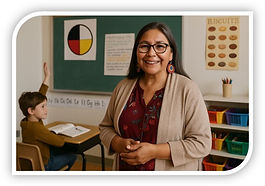
At Prairie View School, efforts to support inclusion have largely centered around academic accommodations and physical accessibility. Classrooms are becoming more adaptable, and teachers are beginning to implement Universal Design for Learning strategies. But Sherry, a Cree educational assistant and community knowledge keeper, quietly observes that something deeper is still missing for many of her Indigenous students. Despite these surface-level changes, some students seem disengaged, withdrawn, or emotionally distant. She senses an invisible barrier, one tied not to ability, but to identity.
Sherry begins gently opening conversations with staff, asking how they define access and inclusion. For her, true access also means connection to culture, language, land, and spiritual practices. She shares stories and teachings passed down in her own family and helps teachers see how identity-affirming learning experiences can be a powerful entry point. Slowly, teachers begin to listen. They start asking different questions, not just “Can the student complete this task?” but “Does this learning invite them to show up fully?”
Throughout the year, Sherry co-plans classroom activities that honor seasonal rhythms, integrate Indigenous languages, and create space for land-based learning. She collaborates with Elders, builds relationships with families, and supports students in walking between worlds, their community traditions and the expectations of formal schooling. Her presence invites not only new practices, but new mindsets: that access must be defined by those seeking it, and that inclusion without cultural responsiveness is still a form of exclusion.
Sherry’s story reveals that inclusion is not just structural—it’s deeply relational. It asks educators to move beyond standard supports and co-create environments where every learner sees themselves reflected in the curriculum, respected in the community, and rooted in who they are.
-
Prologue - Walking Between Worlds ( 📖 Read | 🎧 Listen | 🎬 Watch )
-
Chapter 1 - More Than a Moment ( 📖 Read | 🎧 Listen | 🎬 Watch )
-
Chapter 2 - The Blanket Shelf ( 📖 Read | 🎧 Listen | 🎬 Watch )
-
Chapter 3 - Listening to the Land ( 📖 Read | 🎧 Listen | 🎬 Watch )
-
Chapter 4 - Threads of Belonging ( 📖 Read | 🎧 Listen | 🎬 Watch )
-
Epilogue - A Place for All of Us ( 📖 Read | 🎧 Listen | 🎬 Watch )

Finding His Way In: Jordan’s Journey With Print-Based Access
Jordan is a bright and thoughtful Grade 5 student at Prairie View School. He’s the kind of learner who surprises teachers with insightful observations, deep questions, and a quiet sense of humor. But despite his intellectual curiosity, Jordan consistently struggles with reading tasks. Assignments that require decoding long passages or navigating dense handouts leave him discouraged. He often shuts down, claiming he’s “just lazy” or “not good at school.” Ms. Lang, his teacher, notices that his strengths shine when content is presented verbally or visually, and she begins to wonder if there’s more beneath the surface.
After a meeting with Jordan’s family and the learning support team, an assessment confirms a print-based learning disability. Jordan has strong comprehension when he hears information but significant difficulty decoding written text. This changes everything for Ms. Lang. She begins to understand that access to reading isn’t just about more practice—it’s about designing instruction that works with, not against, Jordan’s brain. With support, she starts experimenting with text-to-speech tools, audiobooks, video summaries, and multimodal instruction strategies.
As the classroom evolves, so does Jordan. He starts to contribute more, take on leadership roles in discussions, and express himself through podcasts, drawings, and oral presentations. Ms. Lang works with him to build independence and self-advocacy skills, helping him recognize that his challenges are not a reflection of his intelligence. By the end of the year, Jordan sees himself differently, not as someone who’s behind, but as someone who learns in his own way. And his peers see him differently too—not as the kid who can’t read fast, but as a classmate with important ideas and a unique voice.
Jordan’s journey reminds the school that access isn’t just about tools. It's about relationships, expectations, and belief in student potential. With thoughtful design and strong partnerships, students who have been quietly struggling can finally find their place and thrive.
-
Prologue - Why Can’t I Read Like Everyone Else? ( 📖 Read | 🎧 Listen | 🎬 Watch )
-
Chapter 1 - Discovering Jordan’s Access Needs ( 📖 Read | 🎧 Listen | 🎬 Watch )
-
Chapter 2 - Redesigning Learning Materials ( 📖 Read | 🎧 Listen | 🎬 Watch )
-
Chapter 3 - New Ways to Show What He Knows ( 📖 Read | 🎧 Listen | 🎬 Watch )
-
Chapter 4 - Independence and Advocacy ( 📖 Read | 🎧 Listen | 🎬 Watch )
-
Epilogue - “I Can Do This My Way” ( 📖 Read | 🎧 Listen | 🎬 Watch )

The Power of Passion and Predictability
Mateo arrives at Wayfinder Middle School after a turbulent transition from his previous school. Nonspeaking and highly sensitive to sensory input, he often retreats under tables or paces the classroom, especially during unstructured times. Many staff feel unsure how to connect with or support him. But something shifts in the music room. When Mr. Iqbal begins a drum sequence during class, Mateo lifts his head, begins to sway, and then taps along in perfect time. That moment sparks a question: what if rhythm could be Mateo’s way in?
Mr. Iqbal begins to explore rhythm not only as a musical tool but as a foundation for regulation, participation, and connection. Through collaboration with the occupational therapist and other staff, he integrates rhythm into classroom routines, communication systems, and learning tasks. The impact is far-reaching. Mateo becomes more engaged and expressive. His peers become more attuned to group regulation. And Mr. Iqbal begins to see how universal design can emerge from one student’s access point.
Over time, Mateo takes on new roles including collaborator, co-designer, and leader. He creates music-infused projects, co-leads group transitions with his drum taps, and even helps propose changes to sensory spaces in the school. He uses assistive technology to advocate for his needs and to contribute meaningfully to classroom and school culture.
By the end of the year, Mateo is not only present. He is seen, heard, and celebrated.
This story highlights how honoring one student’s rhythm can change the beat of an entire classroom. It is a story of how passion and predictability, when embraced through inclusive design, can become powerful access points for belonging and expression.
-
Prologue - Finding His Rhythm ( 📖 Read | 🎧 Listen | 🎬 Watch )
-
Chapter 1 - Rhythm and Regulation ( 📖 Read | 🎧 Listen | 🎬 Watch )
-
Chapter 2 - Customizing Tools ( 📖 Read | 🎧 Listen | 🎬 Watch )
-
Chapter 3 - Shared Rhythms ( 📖 Read | 🎧 Listen | 🎬 Watch )
-
Chapter 4 - Designing With, Not For ( 📖 Read | 🎧 Listen | 🎬 Watch )
-
Epilogue - The Power of Voice ( 📖 Read | 🎧 Listen | 🎬 Watch )

The Dino Lens: Designing Through Deep Interests
Nia is a vibrant Grade 3 student at Harvest Hill Elementary with a deep, unwavering fascination for dinosaurs. Her interest is encyclopedic. She can rattle off species names, habitat facts, and timelines with ease. But in the classroom, her love of dinosaurs often becomes a point of friction. Teachers struggle to redirect her when activities shift focus, and peers sometimes grow frustrated when she brings dinosaurs into every conversation. Her educators find themselves torn: should they try to pull her away from her singular focus, or embrace it as a strength?
During a planning meeting, Nia’s support team, including her classroom teacher, educational assistant, and learning support teacher, begin to look at her through a new lens. With input from her family, they realize that her passion isn’t just a preference; it’s a source of comfort, regulation, and meaning. It helps her navigate sensory overload and social ambiguity. Instead of treating her interest as a limitation, they begin to treat it as a bridge, a way to connect Nia to broader learning and shared classroom experiences.
What follows is a gradual, thoughtful transformation in how learning is designed. The team integrates her dinosaur knowledge into math, literacy, and science lessons, using it as a launching pad rather than a constraint. They introduce predictable routines, co-regulation strategies, and scaffolds that help Nia expand into new areas while staying grounded in what she loves. Over time, she begins to collaborate with peers, explore adjacent topics, and share her learning with confidence. Her story shows that true access sometimes begins not with redirection, but with recognition: of who a child is, what brings them joy, and how that joy can unlock potential.
-
Prologue - Why Is It Always Dinosaurs? ( 📖 Read | 🎧 Listen | 🎬 Watch )
-
Chapter 1 - An Invitation In ( 📖 Read | 🎧 Listen | 🎬 Watch )
-
Chapter 2 - Designing Access Through Interests ( 📖 Read | 🎧 Listen | 🎬 Watch )
-
Chapter 3 - Expanding the Learning Horizon ( 📖 Read | 🎧 Listen | 🎬 Watch )
-
Chapter 4 - Sharing and Collaborating ( 📖 Read | 🎧 Listen | 🎬 Watch )
-
Epilogue - Dinosaurs Brought Me Here ( 📖 Read | 🎧 Listen | 🎬 Watch )

Starting Somewhere: Executive Function as an Access Point
Elias is a quiet and perceptive Grade 8 student at Wayfinder Middle School. While his teachers describe him as capable and insightful, they also express growing concern about his inconsistent work habits. Elias often stares blankly at the start of class, fidgets with unrelated objects, or gazes out the window when others begin working. Assignments are frequently left incomplete. Teachers believe this is not because he lacks the skill or knowledge, but because they never really get off the ground. To many, it looks like he just doesn’t care.
But a deeper look reveals something else entirely. Elias is not defiant. He’s stuck. His brain struggles with executive functioning tasks like planning, organizing, and initiating. Starting is the hardest part. Once he’s in the flow, he can contribute thoughtful ideas and original work. Unfortunately, classroom structures often assume that students know how to begin, how to plan, and how to persist, all of which are invisible hurdles for Elias.
After a student services team meeting and some intentional observation, Elias’s teachers begin shifting their lens. Instead of framing the problem as motivation, they begin to understand it as access. Access to the “how” of learning, not just the “what.” With small, strategic supports like visual checklists, clear planning routines, and student agency Elias begins to build momentum. His story shows how executive function isn’t just a clinical label, but a powerful access point for equity and engagement when educators lean in with curiosity and design with intention.
-
Prologue - Misunderstood Starts ( 📖 Read | 🎧 Listen | 🎬 Watch )
-
Chapter 1 - Curiosity as Compass ( 📖 Read | 🎧 Listen | 🎬 Watch )
-
Chapter 2 - Rethinking the Problem ( 📖 Read | 🎧 Listen | 🎬 Watch )
-
Chapter 3 - Rethinking Motivation ( 📖 Read | 🎧 Listen | 🎬 Watch )
-
Chapter 4 - Stepping In and Stepping Back ( 📖 Read | 🎧 Listen | 🎬 Watch )
-
Epilogue - Building Momentum ( 📖 Read | 🎧 Listen | 🎬 Watch )
© 2025 by The Belonging Project. Website created with Wix.com