


Understanding the Escalation Cycle: Supporting Regulation
This course explores the stages of the escalation cycle and offers inclusive, compassionate strategies to support students through stress, dysregulation, and crisis moments. Participants will learn how to recognize early signs of escalation, design environments that prevent triggers, and respond effectively during peak and recovery phases. The course emphasizes co-regulation, emotional safety, and relational repair as foundations for long-term change. Through narrative case studies and practical tools, educators will build capacity to support all learners, especially those most impacted by trauma, anxiety, or unmet needs, within safe and connected school environments.
Start Here
Welcome to the course! This learning experience is designed to help you explore inclusive education through a blend of practical strategies and powerful storytelling. Before diving into the course content, your first step is to choose the story that will guide your learning.
About This Course
This course supports you in building inclusive, flexible learning environments that recognize and amplify the strengths of every learner. While you’ll deepen your understanding through interactive learning interludes, everything begins with story.
Each course is anchored in a set of narrative case studies—realistic, practice-based stories that illuminate inclusive strategies in action. These stories will help you reflect, connect, and see how the course concepts apply in real school contexts.
Choose Your Story
Each story features:
-
A Prologue to set the scene
-
Four Chapters that trace growth, tension, and change
-
An Epilogue to reflect on learning and impact
Choose one story to follow throughout the course. Pick the one that most closely matches your role, context, or interests. This story will provide a consistent lens as you move through the learning interludes and activities.
Not sure which to choose? No problem. You can always return to this page to explore other stories. Many learners choose to follow more than one story to see how inclusive practices come to life in different settings.
What Happens Next?
Once you’ve chosen your story:
-
If you're learning independently, head to the Course Content section and begin with Learning Interlude 1.
-
If you're learning with a facilitator, they’ll guide you through the journey using the facilitation materials provided.
You're ready to begin. Scroll down to explore the stories and pick the one that will guide your path through the course.

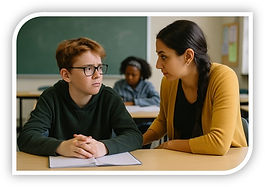
Meeting Marcus
Marcus is a perceptive, intelligent Grade 7 student with a sharp sense of fairness, quick wit, and a sensitive nervous system shaped by both ADHD and early trauma. On the outside, he often appears disengaged or indifferent, but internally, he is navigating unpredictable waves of stress and vigilance. His new teacher, Ms. Hariri, is energetic and organized, eager to build trust with a complex group of learners.
Early in the school year, Marcus’s challenges remain mostly hidden. Then, without much warning, they begin to surface. His escalations come quickly and unexpectedly, catching staff off guard. Over time, Ms. Hariri begins to recognize the slow buildup of stress that precedes these moments and shifts her own posture from reactive to responsive. Through honest conversations, collaborative planning, and a growing culture of emotional safety, both Marcus and his teacher begin to experience the classroom in new ways.
This is not a story about fixing a student. It is a story about noticing, listening, co-creating, and rebuilding trust, over and over again.
-
Prologue - First Signs ( 📖 Read | 🎧 Listen | 🎬 Watch )
-
Chapter 1 - Triggers and Tensions ( 📖 Read | 🎧 Listen | 🎬 Watch )
-
Chapter 2 - The Escalation Curve ( 📖 Read | 🎧 Listen | 🎬 Watch )
-
Chapter 3 - Crisis Moments ( 📖 Read | 🎧 Listen | 🎬 Watch )
-
Chapter 4 - Repair, Reflect, and Rebuild ( 📖 Read | 🎧 Listen | 🎬 Watch )
-
Epilogue - The Power of Connection ( 📖 Read | 🎧 Listen | 🎬 Watch )

Under the Surface
Ariana is a quietly brilliant Grade 3 student with a love of art, a tender heart, and a diagnosis of selective mutism and anxiety. At school, she communicates only through gestures and written work, and even that takes courage. Most days, she fades into the background, an easy child to overlook. But under the surface, Ariana is constantly managing an invisible current of stress, scanning for safety in a world that often misunderstands her silence.
Her teacher, Mr. Leblanc, is caring and observant, but unsure at first how to reach her. After a public emotional shutdown in class, he begins to dig deeper into the relationship between anxiety, control, and escalation. With time, he learns that escalation does not always look loud. Sometimes, it looks like stillness. Or retreat. Or tears behind quiet eyes.
This is a story about trust. It is not about quick fixes. It is about learning to respond without demands, creating space for students to feel safe enough to stay present, and recognizing that voice takes many forms.
-
Prologue - The Quiet Storm ( 📖 Read | 🎧 Listen | 🎬 Watch )
-
Chapter 1 - Building Emotional Safety ( 📖 Read | 🎧 Listen | 🎬 Watch )
-
Chapter 2 - Escalation in Silence ( 📖 Read | 🎧 Listen | 🎬 Watch )
-
Chapter 3 - Gentle Crisis Support ( 📖 Read | 🎧 Listen | 🎬 Watch )
-
Chapter 4 - Trust as a Tool for De-escalation ( 📖 Read | 🎧 Listen | 🎬 Watch )
-
Epilogue - A New Kind of Voice ( 📖 Read | 🎧 Listen | 🎬 Watch )

Break Time, Boiling Point
Jaden is an energetic, affectionate Grade 6 student diagnosed with FASD. He thrives when routines are clear and movement is structured. When things get loud, unpredictable, or unsupervised, however, his body takes over before his brain can catch up.
Recess, especially, is a volatile time. It starts with promise, filled with running games and laughter, but often ends in tension, with Jaden storming back into class frustrated, overwhelmed, or on the edge of losing control.
Ms. Samuels, Jaden’s educational assistant, works hard to support him but finds herself correcting him constantly, unintentionally feeding into his stress. Over time, both she and the school team begin to shift their thinking. Instead of focusing on stopping behavior, they begin to focus on recognizing escalation, designing for success, and restoring relationships when things fall apart.
This story is about transitions, timing, and the importance of adult self-regulation. It is about helping students feel safe in their bodies and offering strategies that actually work in the moment rather than just in theory.
-
Prologue - Recess Revolves Around Risk ( 📖 Read | 🎧 Listen | 🎬 Watch )
-
Chapter 1 - Recognizing the Cycle ( 📖 Read | 🎧 Listen | 🎬 Watch )
-
Chapter 2 - Pre-Escalation Planning ( 📖 Read | 🎧 Listen | 🎬 Watch )
-
Chapter 3 - When It Boils Over ( 📖 Read | 🎧 Listen | 🎬 Watch )
-
Chapter 4 - Restoring Belonging ( 📖 Read | 🎧 Listen | 🎬 Watch )
-
Epilogue - Seeing Strengths First ( 📖 Read | 🎧 Listen | 🎬 Watch )

Patterns and Promises
Terrell is a sharp, observant Grade 9 student who carries the weight of systemic exclusion. After being suspended multiple times at his previous school, he’s learned to walk out before things get worse. To others, he appears defiant. To those who listen closely, his behavior is protective. He puts up a shield against judgment, misunderstanding, and unseen harm.
At Horizon Outreach, staff are committed to doing things differently. But even with that intention, patterns of adult misreading and institutional blind spots still emerge. Over time, staff begin to see Terrell’s dysregulation not as a disciplinary problem, but as a signpost. They start to understand it as a call to see what lies beneath.
This story is about cultural safety, adult self-awareness, and the difference between discipline and dignity. It’s about what happens when students are invited to stay, not forced to conform.
-
Prologue - Mistrust in the Room ( 📖 Read | 🎧 Listen | 🎬 Watch )
-
Chapter 1 - What Lies Beneath ( 📖 Read | 🎧 Listen | 🎬 Watch )
-
Chapter 2 - Escalation Is a Signal ( 📖 Read | 🎧 Listen | 🎬 Watch )
-
Chapter 3 - Safe Adults, Predictable Steps ( 📖 Read | 🎧 Listen | 🎬 Watch )
-
Chapter 4 - Community Repair ( 📖 Read | 🎧 Listen | 🎬 Watch )
-
Epilogue - Choosing to Stay ( 📖 Read | 🎧 Listen | 🎬 Watch )
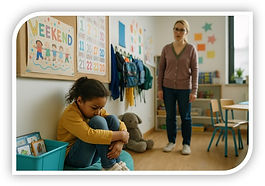
Every Little Thing
Tiana is a bright, imaginative six-year-old who lights up when she talks about animals, patterns, or her favorite stories. But even small disruptions such as an unexpected assembly, a loud pencil sharpener, or a rushed transition can send her into distress. She does not lash out at others. Instead, her world becomes too much, too fast, and she either melts down or shuts down.
Her teacher, Ms. Clarke, knows that Tiana’s behavior is not defiance. It is dysregulation. With a team approach and thoughtful design, Ms. Clarke begins to shift the classroom rhythm so that regulation, predictability, and voice become part of the learning experience for all students.
This story is about recognizing stress behavior, planning proactively, and empowering even the youngest learners with tools for self-awareness and shared safety.
-
Prologue - Too Much, Too Fast ( 📖 Read | 🎧 Listen | 🎬 Watch )
-
Chapter 1 - Triggers in the Environment ( 📖 Read | 🎧 Listen | 🎬 Watch )
-
Chapter 2 - Preventing Escalation ( 📖 Read | 🎧 Listen | 🎬 Watch )
-
Chapter 3 - When Overwhelm Wins ( 📖 Read | 🎧 Listen | 🎬 Watch )
-
Chapter 4 - Empowering Regulation ( 📖 Read | 🎧 Listen | 🎬 Watch )
-
Epilogue - Empowered and Understood ( 📖 Read | 🎧 Listen | 🎬 Watch )

It’s Not Just the Student
Ms. Johal is a veteran Grade 2 teacher who is deeply committed, highly skilled, and beloved by her students. But lately, the work has felt harder. Small conflicts erupt. Her patience feels thin. And one afternoon, she snaps at a student for talking during quiet time. The room goes silent, and so does her heart.
What unfolds is not just a behavior plan or a classroom intervention. It is a journey inward.
Through coaching, reflection, and daily practice, Ms. Johal learns to recognize her own escalation cycle. She begins to model what she most hopes her students will learn: how to pause, regulate, and reconnect.
This story highlights the profound impact of adult nervous systems, the power of vulnerability, and the shift from reactive management to relational leadership.
-
Prologue - The Day Everything Felt Too Loud ( 📖 Read | 🎧 Listen | 🎬 Watch )
-
Chapter 1 - The Escalation Loop ( 📖 Read | 🎧 Listen | 🎬 Watch )
-
Chapter 2 - Rewriting the Playbook ( 📖 Read | 🎧 Listen | 🎬 Watch )
-
Chapter 3 - Holding Space in the Moment ( 📖 Read | 🎧 Listen | 🎬 Watch )
-
Chapter 4 - A Culture Shift ( 📖 Read | 🎧 Listen | 🎬 Watch )
-
Epilogue - I’m Not the Same Teacher ( 📖 Read | 🎧 Listen | 🎬 Watch )

Ripple Effects
Mr. Neufeld has been in school leadership for over a decade. He is calm under pressure, decisive, and deeply cares about student safety. But lately, the strategies that once worked such as firm consequences, heightened supervision, and suspension are not solving the real problem.
When a fight erupts in the cafeteria and ends with a student being physically restrained, something breaks open in him.
He begins a deeper inquiry, not just into student behavior, but into the conditions that allow escalation to build. With courage and humility, he invites staff to see the bigger picture: how adult responses, the environment, and the absence of regulation systems contribute to the cycle.
Together, they begin shifting Summit Grove’s culture. One hallway, one routine, one mindset at a time.
This story captures the complexity of leading systemic change and the quiet revolutions that happen when safety is redefined to include emotional well-being.
-
Prologue - The Cafeteria Incident ( 📖 Read | 🎧 Listen | 🎬 Watch )
-
Chapter 1 - Stepping Back to See the Pattern ( 📖 Read | 🎧 Listen | 🎬 Watch )
-
Chapter 2 - From Control to Connection ( 📖 Read | 🎧 Listen | 🎬 Watch )
-
Chapter 3 - In the Heat of the Moment ( 📖 Read | 🎧 Listen | 🎬 Watch )
-
Chapter 4 - Shared Language, Shared Tools ( 📖 Read | 🎧 Listen | 🎬 Watch )
-
Epilogue - A Different Kind of Safety Plan ( 📖 Read | 🎧 Listen | 🎬 Watch )

Bridging the Gaps
Tanya has worked in inclusive education for over a decade. She is responsive, skilled, and known for her calm presence in the most difficult moments. But over time, she has grown weary of being the one called in after things explode.
Each crisis referral feels more urgent. Each school team more exhausted. Each plan reactive.
Tanya begins to realize that without systems level change, the cycle will continue no matter how well she supports individual students.
She pivots from being a responder to being a relationship builder, a guide, and a catalyst for alignment across schools. Her story is one of moving from putting out fires to helping schools fireproof through connection, planning, and shared ownership.
-
Prologue - Another Referral, Same Pattern ( 📖 Read | 🎧 Listen | 🎬 Watch )
-
Chapter 1 - Beyond Triage ( 📖 Read | 🎧 Listen | 🎬 Watch )
-
Chapter 2 - Staff Capacity, Not Just Student Plans ( 📖 Read | 🎧 Listen | 🎬 Watch )
-
Chapter 3 - Holding Systems Accountable ( 📖 Read | 🎧 Listen | 🎬 Watch )
-
Chapter 4 - Building Bridges Across Schools ( 📖 Read | 🎧 Listen | 🎬 Watch )
-
Epilogue - Systemic Change Starts Small ( 📖 Read | 🎧 Listen | 🎬 Watch )
© 2025 by The Belonging Project. Website created with Wix.com